



Vetus Anti-Siphon Valves

Vetus Anti-Siphon Valves: Engine Protection You Can Count On
Vetus has been a trusted name in marine engineering anti-siphon valves and exhaust protection since its founding in 1964. Vetus is renowned for designing products that solve real-world boating problems, and their anti-siphon valve lineup is no exception — offering precision-engineered protection for one of the most vulnerable parts of any marine engine installation.
Why Anti-Siphon Valves Matter on Your Boat
On many boat installations, if the point where cooling water is injected into the exhaust hose is less than 6" (15 cm) above the waterline, there is a risk that cooling water will siphon back into the exhaust system and subsequently into the engine itself when the engine is shut off. This silent threat can cause catastrophic hydrolocking damage to an engine — often with no warning signs whatsoever. An anti-siphon valve (also called a vented loop or air vent) is the standard defense against this scenario.
Vetus ASDV and AIRVENT Product Lines
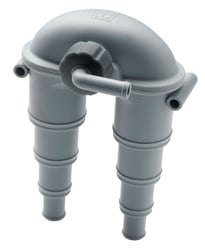
Vetus offers two primary families of anti-siphon devices, each engineered for a specific installation preference. Four different models are available in two different styles: the AIRVENT models feature a “flat top” shape, and “V” versions (AIRVENTV) include a normally-closed, integral anti-siphon joker valve that allows air to enter the exhaust system to break the siphon when the engine is shut off.
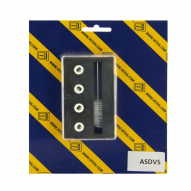
The more advanced ASDV series builds on the AIRVENT foundation with a key practical upgrade. Type ASDV air vents are interchangeable with type AIRVENT and have the same fixing hole centers — with the added advantage that the air bleed connection rotates through 360°, and the valve can be maintained without removing the vent from the wall. No tools are required for this maintenance, and a replacement set of 5 valves is available as a spare part.
For installations where valve maintenance is a concern, the “H” (AIRVENTH) models come with hose which is led to a supplied overboard thru-hull fitting, allowing air to enter back into the exhaust system to break the siphon — with the advantage of being maintenance-free, since there is no valve to become clogged with salt crystals.
Proper Installation for Maximum Protection
Getting the most from a Vetus anti-siphon valve requires proper placement. To maximize effectiveness, the vent must be placed at least 40 cm (16") above the waterline, and for sailing vessels, it should be positioned as close to midships as possible to prevent it from falling below the required height when the ship heels under sail.
The device features a reliable anti-siphon valve, a 360° rotating air bleed, and tool-free maintenance for dependable protection. Vetus also notes that stepped hose fittings accommodate 13 mm, 19 mm, 25 mm, and 32 mm ID hose — making these units broadly compatible with most raw-water cooling circuits found on recreational and light commercial vessels.
Why Choose Vetus for Anti-Siphon Protection?
Since its foundation in 1964, VETUS has become a world leader in the manufacture of innovative products for leisure craft and small commercial vessels. With more than 4,000 technical products covering 14 systems, at least 70% of Vetus products are designed and developed by their own R&D department. That in-house engineering focus means that even a component as compact as an anti-siphon valve receives the same rigorous design attention as a full engine or thruster system. Whether you choose the tool-free ASDV or the maintenance-free hose-style AIRVENT, Vetus delivers the reliability that serious boaters depend on.