



Isolation Transformers
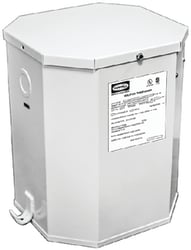
Hubbell HBL50AITW Marine Isolation Transformer 15kVA 60Hz White Powder Coat

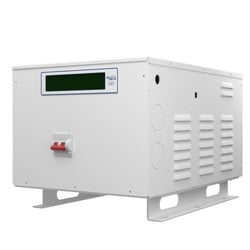
Asea Power 628009001 DBT12 GEN 2 Dock Boost Transformer Marine Shore Power
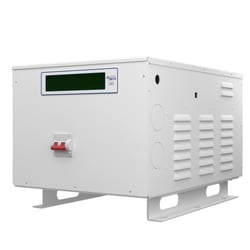
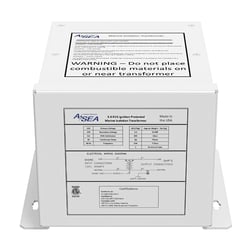
What Is a Marine Isolation Transformer?
Every time a boat connects to shore power at a marina, it faces a hidden set of electrical hazards — stray currents, voltage spikes, reversed polarity, and the slow but relentless threat of galvanic corrosion. A marine isolation transformer is the cornerstone defense against all of these risks. Rather than allowing a hard-wired electrical connection between the dock and your vessel, an isolation transformer works through electromagnetic induction: shore power energizes a primary winding, which creates a magnetic field in the transformer core, inducing electricity in a secondary winding connected to the boat. The result is that there is no direct metallic path between the shore and the boat's electrical system — and that separation makes all the difference.
Why Isolation Transformers Matter on the Water
The marine environment is uniquely demanding. Saltwater is an excellent electrical conductor, and when multiple boats share a common dock ground, stray currents can flow freely between vessels, accelerating corrosion of propellers, shafts, rudders, and through-hull fittings. Isolation transformers address this by eliminating the conductive path that allows galvanic currents to flow, effectively putting a firewall between your boat and the rest of the marina's electrical grid.
Beyond corrosion, marina shore power is notoriously inconsistent. Voltage fluctuations, surges, and spikes can damage sensitive marine electronics, battery chargers, and onboard appliances. An isolation transformer acts as an electrical buffer, smoothing these irregularities and delivering stable, regulated power to onboard systems. They also solve the reversed-polarity problem: if a dock's hot and neutral wires are accidentally swapped — a real-world hazard in older or poorly maintained marinas — the transformer's magnetic induction process re-polarizes the output correctly, protecting both crew and equipment.
There is also a critical safety benefit for swimmers. Without isolation, a loose wire on a boat can send fault current through the hull and into the surrounding water — a condition known as Electric Shock Drowning. Isolation transformers eliminate this pathway entirely, since the shore ground terminates at the transformer shield and a new, independent ground is established for the vessel.
What to Look for When Choosing an Isolation Transformer
- Voltage compatibility: Match the transformer to your boat's electrical system — common options are 120V for smaller vessels and 240V for split-phase systems on larger boats.
- Capacity (kVA/amperage): Size the unit to handle your total onboard electrical load. Common configurations include 30-amp units for smaller boats and 50-amp units for larger yachts and liveaboards.
- ABYC compliance: Look for transformers that meet recognized standards such as ABYC E-11 and ABYC C-1500, especially for gasoline-powered vessels where ignition protection is mandatory.
- Construction quality: Potted (fully sealed) transformers offer superior resistance to moisture, vibration, and the harsh marine environment compared to open-frame designs.
- Soft-start technology: Integrated soft-start circuitry prevents inrush current surges when first connecting to shore power, protecting both the transformer and the dock's circuit breakers.
Top Brands in Marine Isolation Transformers
Asea Power Systems is a specialist in marine power conversion equipment, building isolation transformers engineered specifically for demanding onboard environments. Their units are certified to ABYC C-1500, UL 1500, and UL 1561 standards, making them ignition-protected and suitable for both gasoline- and diesel-powered vessels. Asea's potted transformer design delivers enhanced moisture resistance and vibration dampening, and their lineup is fully compliant with NEC 555.35 marina safety requirements.
MasterVolt brings a different engineering approach with their Mass GI series, which leverages high-frequency electronic switch technology to produce isolation transformers that are dramatically more compact and lightweight than traditional low-frequency designs. Their units are compatible with wide input voltage ranges (90–255V) and multiple frequencies, making them an excellent choice for cruisers that travel internationally and encounter varying shore power standards. Multiple units can also be parallel-coupled to scale capacity as onboard electrical loads grow.