



Plaques, Decals & Identi-Plates






Keep Your Vessel Identified, Compliant, and Organized
Whether you're a weekend lake cruiser or an offshore blue-water sailor, proper vessel identification isn't just good seamanship — it's the law. Marine plaques, decals, and identi-plates are the essential markers that connect your boat to its legal identity, help authorities locate you in an emergency, and keep every switch and circuit on your helm clearly labeled for safe operation.
Registration Decals: Your Boat's License Plate
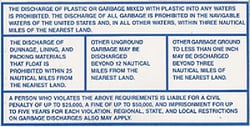
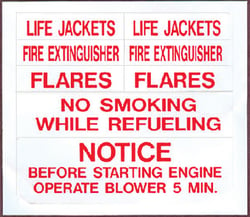
Boat registration numbers function as your vessel's license plate, making it easier for marine patrol and other authorities to identify your boat on the water. Registration decals and lettering kits typically come in vinyl or rigid plastic formats engineered to survive the punishing marine environment — UV exposure, fuel splash, salt spray, and constant moisture. Most states require registration characters to be at least three inches in height, displayed in block lettering that contrasts with the hull color, and affixed to the forward half of both the port and starboard sides of the vessel. Choosing a high-quality decal rated for outdoor marine use helps ensure your numbers stay legible season after season without fading, peeling, or cracking.
Documentation Plaques: Meeting USCG Requirements
For vessels that are federally documented with the U.S. Coast Guard, a boat documentation plaque is a critical compliance item. Federal regulations require that the official vessel number — preceded by the abbreviation "NO." — be permanently marked in block-type Arabic numerals no less than three inches in height on a clearly visible interior structural part of the hull. The plaque must be fastened so that its removal would be obvious, meaning both adhesive and screws are typically required. These plaques are commonly made from engraved teak, hard plastic, or metal to satisfy the permanence standard set by 46 C.F.R. § 67.121.
Hull Identification Numbers (HIN): Your Vessel's Serial Number
Every recreational boat built or imported in the United States after 1972 is required to have a Hull Identification Number (HIN) — a unique 12-digit code that identifies the manufacturer, serial number, and production date of the vessel. The HIN functions much like a VIN on an automobile: it's used for state registration, title transfers, safety recalls, and stolen boat investigations. HIN plates and labels must be permanently affixed to the upper starboard corner of the transom, with a duplicate placed in a concealed interior location per federal regulations.
Identi-Plates: Organizing Your Helm and Electrical Panel
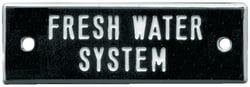
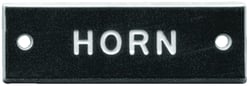
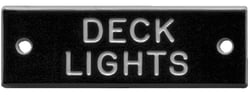
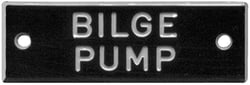
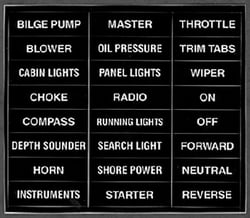
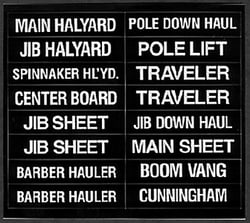
Beyond regulatory compliance, identi-plates serve a critical onboard safety role by clearly labeling every switch, breaker, and circuit on your vessel's electrical panel. A well-labeled helm prevents costly mistakes — and potentially dangerous ones — when you need to isolate a circuit quickly in an emergency. Standard identi-plates are typically small molded plastic labels with engraved white-on-black text, designed to be screwed or adhered directly to switch panels. Common labels include navigation lights, bilge pumps, blower circuits, fuel pumps, and dozens of other functions.
What to Look for When Shopping
- Material durability: Look for UV-coated vinyl, outdoor-grade adhesives, or rigid molded plastic rated for prolonged marine exposure.
- Character size compliance: Confirm that registration lettering meets your state's minimum height requirements — most states mandate at least 3-inch block characters.
- Mounting method: Consider your hull material. Fiberglass and metal hulls typically accept pressure-sensitive vinyl well, while wood hulls may be better suited to screw-mounted hard plastic plates.
- Contrast: Registration numbers must contrast clearly with the background color of the hull for easy readability by law enforcement on the water.
- Complete kits vs. individual characters: Registration kits include lettering for both sides of the vessel and arrive pre-arranged for quick, accurate installation.
From compliance essentials to helm organization, the right plaques, decals, and identi-plates make sure your vessel is ready for inspection — and ready for the water.