



Flattening Agent
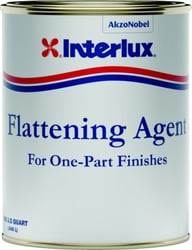

What Is a Marine Paint Flattening Agent?
When you're refinishing a boat hull, cabin interior, or topsides, the sheen of the final coat matters just as much as the color. A flattening agent — sometimes called a matting additive or flatting agent — is a specialized paint additive that lets you dial in exactly how much gloss your topcoat delivers. Rather than being locked into a single finish level straight from the can, you can blend a flattening agent directly into your paint or varnish to achieve a custom satin, semi-gloss, or fully matte result.
Marine-grade flattening agents are engineered specifically for the demanding conditions boats endure — constant UV exposure, salt spray, moisture, and abrasion. They work by introducing fine particles (typically silica-based) into the paint film, which scatter light at the surface and reduce the perceived gloss level. The more flattening agent you add to the mix, the lower the resulting sheen.
Why Gloss Level Matters on a Boat
Gloss control isn't purely an aesthetic choice. Full-gloss coatings are prized for their slick, easy-clean surfaces — water and contaminants bead and shed more readily. However, there are plenty of scenarios on a boat where lower-gloss finishes make sense: interior cabin surfaces where glare reduction improves comfort, non-skid accent areas, wood trim that needs a more natural look, or any application where a mirror finish would look out of place.
Because most high-performance marine paints are formulated in full gloss, a flattening agent is often the only practical way to step down the sheen without switching products entirely. It's worth noting that reduced-gloss finishes generally don't have quite the same stay-clean properties as their full-gloss counterparts, so gloss-level choice should factor in both aesthetics and intended use.
How to Use a Flattening Agent
Using a flattening agent correctly is straightforward, but a few best practices make a significant difference in results:
- Stir each product individually before combining them in a separate mixing container.
- Test your ratio on a small area first — the exact gloss level achieved can vary by color, film build, and application method.
- Apply flattened finish as the final coat, using full-gloss base coats underneath for maximum opacity and hide before switching to the matted topcoat.
- Keep the mix stirred during application, as the flattening particles can settle over time.
- Be aware that application method matters: spraying thin and dry will reduce gloss further than wet, heavy brush coats.
Flattening Agents for 1-Part vs. 2-Part Finishes
Not all flattening agents are interchangeable. Products formulated for single-component (1-part) enamels and polyurethanes are not suitable for use in two-part polyurethane systems, and vice versa. Always confirm compatibility with your specific topcoat before mixing, and follow the manufacturer's recommended mix ratios closely for consistent results.
Top Brands in Marine Flattening Agents
Interlux Paint is the leading name in marine flattening agents, offering purpose-built products for both 1-part and 2-part systems. Their flattening agent for 1-part finishes is specially formulated to mix with Brightside Polyurethane, Yacht Enamels, and their line of varnishes — including Schooner Gold and Original — giving boat owners precise control over finish sheen without compromising the durability or drying characteristics of the underlying paint system.