



Penetrating Lubricants

What Are Penetrating Lubricants and Why Do They Matter?
Any boater or RV owner who has wrestled a seized bolt, fought a salt-corroded fitting, or watched moisture creep into an electrical connector knows the value of a high-quality penetrating lubricant. These specialized formulas are engineered to do what heavier greases and oils simply cannot: infiltrate the microscopic gaps between corroded metal surfaces, displace trapped moisture, dissolve rust, and restore movement to components that have locked up from exposure to water, salt, heat, and time.
In the RV and marine world, the challenge is especially demanding. Saltwater environments accelerate corrosion at a remarkable rate, and the constant vibration of engines and road travel works fasteners loose only to have them bind up again with rust. Penetrating lubricants are a front-line defense — applied to hinges, jack stands, slide-out mechanisms, engine components, electrical connections, throttle cables, and dozens of other critical points to keep everything moving freely and protected against the elements.
How Penetrating Lubricants Work
Unlike conventional greases, penetrating lubricants rely on low-viscosity carrier solvents to seep deep into tight crevices and corroded threads. Once inside, they displace moisture and dissolve rust and oxidation. Many formulas then leave behind a protective film — whether a waxy coating, a thin oil layer, or a dry film — that continues to lubricate and guard the metal long after the solvents have evaporated. When shopping this category, consider the environment you're working in: saltwater marine applications demand a waterproof, long-lasting formula, while general RV maintenance may call for something versatile enough to use on both metal surfaces and electrical components.
Top Penetrating Lubricant Brands for RV & Marine
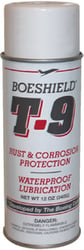
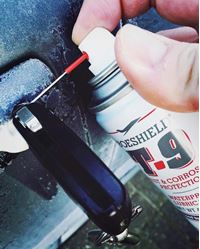
Boeshield T-9 is the category standout for demanding marine and RV use. Originally developed and licensed by The Boeing Company to meet aerospace-grade corrosion protection requirements, Boeshield T-9's formula uses a proprietary blend of carrier solvents and paraffin wax. Its low-viscosity formulation penetrates deeply into pores and tight spaces, then dries to a clean, waxy, waterproof film that clings to metal for months — without silicone, Teflon, fluorocarbons, or harsh solvents. It's equally trusted on boat decks, RV slide-outs and step mechanisms, engine compartments, and electrical circuits.
LPS Lubricants brings an industrial-grade lineup to the penetrating lubricant space, with a tiered product range — LPS 1, LPS 2, and LPS 3 — designed for progressively heavier-duty applications. LPS 1 offers a dry, thin lubricating film that fast-acts to displace moisture and loosen rusted or frozen parts, while LPS 2 provides heavy-duty penetration with added corrosion protection. LPS products are engineered across a broad range of applications, including automotive, industrial, aerospace, and marine environments, making them a highly versatile choice for multi-use shops and serious DIYers alike.
CRC Industries has been a trusted name in marine chemical maintenance for decades. Their flagship 6-56 Multi-Purpose Lubricant — a core product since CRC's marine line launched in the 1970s — resists water and salt spray, penetrates through rust and corrosion, and helps start wet engines, making it a go-to for boaters. CRC also offers the Ultra Screwloose super penetrant, a fast-acting concentrated formula that instantly soaks into the smallest crevices to free seized fasteners and mechanical components.
BikeMaster rounds out the category with penetrating lubricant solutions suited for powersports and recreational applications, offering a practical option for riders and outdoor enthusiasts who need reliable corrosion protection and lubrication on cables, fasteners, and moving parts.
Key Considerations When Choosing a Penetrating Lubricant
- Environment: Saltwater and marine use demands a waterproof, long-lasting formula that won't wash away.
- Surface compatibility: Verify the product is safe on paint, fiberglass, vinyl, rubber, and plastics common in RV and marine builds.
- Residue type: Wax or dry-film formulas resist dirt buildup; oily films offer longer-term protection on stored equipment.
- Electrical safety: For wiring, connectors, and ignition components, choose a non-conductive formula that won't cause shorts.
- Application format: Aerosol cans with precision straws excel at reaching tight spaces; liquid drip bottles suit precision work on chains and cables.