



Tail Light Converters
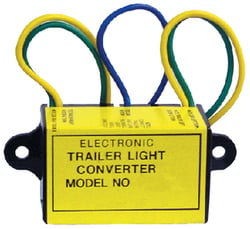

What Is a Tail Light Converter?
When you hitch up a trailer and hit the road, every vehicle behind you needs to see your brake lights, turn signals, and running lights — on the trailer, not just the tow vehicle. That's where a tail light converter comes in. This compact but critical piece of trailering hardware bridges the electrical gap between your vehicle's lighting system and your trailer's lights, ensuring that both communicate the same signals at the same time.
Vehicles today use different wiring systems to carry out electrical functions — specifically for taillights, stop or brake lights, and turn signals. As vehicles have advanced, these wiring systems have changed, and to provide a proper wiring connection for towing a trailer, an electrical converter is often required.
Why You Might Need One
Most trailers operate on a two-wire system where the brake lights and turn signals operate on the same wire. When the towing vehicle has separate wires for brake lights and turn signals, a tail light converter is required. This mismatch is extremely common in modern cars and trucks, making a converter a near-essential item for anyone who tows a boat, camper, utility trailer, or RV-related equipment.
At the core of a tail light converter is a series of relays and diodes that enable the conversion of signals from the tow vehicle's lighting system to match the requirements of the trailer's lighting system. Diodes are used to prevent electrical signals from being sent back to the vehicle's electrical system, which could cause damage — they allow signals to flow in one direction, ensuring the trailer's lights operate correctly without affecting the vehicle's electrical system.
Powered vs. Non-Powered Converters
Powered taillight converter kits work by supplying the power necessary for the trailer tail lights through a separate wire from the vehicle's battery, whereas non-powered systems use the vehicle's existing wiring to power the converter and lights. Powered taillight converters are safer and less likely to cause issues with your vehicle's existing wiring systems. For modern vehicles with sensitive electronics or complex lighting circuits, a powered converter is typically the recommended choice.
Common Wiring Configurations
Tail light converters come in several configurations to match the diversity of tow vehicles on the road today:
- The two-wire system is the simplest form of vehicle and trailer wiring, still used by some vehicles today. It sends the stop and turn signals along one wire and the taillight signal along a second wire.
- The three-wire system is the most common in the automotive industry. It sends the stop, taillight, and turn signals along three separate wires — vehicles with this system usually require a converter.
- More and more vehicles today use a PWM (pulse width modulation) system, which requires specialized powered converters to properly interpret and relay signals to the trailer.
What to Look for When Buying
The converter you choose depends on the type of trailer you'll be towing and the car or truck you'll be towing it with. Look for converters that offer built-in circuit protection to safeguard your factory wiring, and verify whether the unit is designed for splice-in installation or plug-and-play compatibility. Most converters provide a standard trailer wiring connector, usually in the form of a 4-way flat. Always confirm compatibility with your specific vehicle year, make, and model before purchasing.