



Panther Drive Belts Outboard Motor Mounting Plates

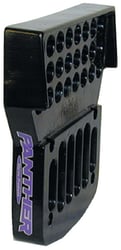
Panther Drive Belts Outboard Motor Mounting Plates
When it comes to securing an outboard to your transom with confidence, few names carry the track record of Panther Drive Belts. Known throughout the marine industry for precision-engineered accessories, Panther brings that same level of craftsmanship to its lineup of outboard motor mounting plates — hardware that quietly does one of the most important jobs on your boat.
Why Mounting Plates Matter
An outboard motor mounting plate is more than a simple spacer between engine and transom. It directly affects how your boat rides, how efficiently your motor transfers power to the water, and whether your hull handles cleanly at speed. The wrong angle — even by a few degrees — can mean a sluggish hole shot, excessive bow rise on heavy-loaded boats, or a bow-light craft that skips and porpoises at cruising speed. A quality mounting plate lets you dial in the geometry before you ever leave the dock.
Panther's Reversible Wedge Mounting Plate
The flagship product in Panther's mounting plate lineup is the 5° Reversible Wedge Mounting Plate. This plate provides 5° of trim or tuck, and its one-piece, cast-aluminum design provides a stable platform for the largest of today's outboards. What makes the reversible design especially practical is its ability to serve two very different hull types from a single piece of hardware.
- Heavy boats benefit from the additional performance of 5° of bow lift.
- Bow-light boats benefit by reversing the wedge, keeping the boat adhered to the water and providing a much-improved hole shot.
- The chromate-dipped, powder-painted mounting wedge offers hole patterns to suit a wide variety of mounting applications, with BIA bolt patterns applied.
The result is a single, versatile component that addresses performance tuning across a broad spectrum of hull and engine combinations — without the need for custom fabrication or specialized tools.
Static Motor Mount Plates for Kicker and Auxiliary Motors
Beyond the wedge plate, Panther also produces static motor mount plates designed to solve one of the most common challenges in multi-motor setups. When direct-to-transom motor mounting is difficult, Panther's Static Motor Mount Plate provides a flat, secure mounting surface for clamp-on or bolt-on kicker motors — two or four stroke — up to 35 hp or 263 lbs. Made of solid cast aluminum with an 8 in. by 7 in. mounting area, the bracket can be used on most contoured boat transoms.
The plate also works for mounting long-shaft motors on short-shaft transoms — because it sets the motor 4 inches higher on the transom, it's ideal for jon boats and small fishing boats where a short-shaft motor would otherwise be required.
For trolling motor applications, Panther's 405 Static Plate offers a sturdy, flat mounting area for trolling motor clamps, so you can troll with confidence knowing your motor stays exactly where you put it.
Build Quality and Warranty
The Motor Mount Bolt Bar supplies added support for your transom when mounting main or auxiliary motors, made from heavy-duty cast aluminum and powder coated for years of like-new looking support. A manufacturer's 1-year limited warranty backs the product. Whether you're rigging a tournament fishing boat, a pontoon with a kicker, or a jon boat for backcountry exploration, Panther's mounting plate solutions are built to handle the load and last in a marine environment.