



Sanders
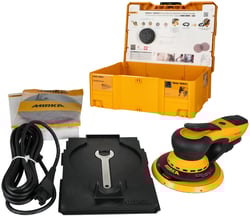

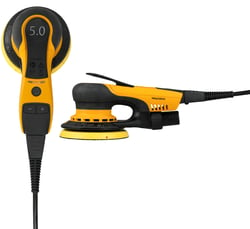
Mirka MID55020CAUS DEROS 5" Electric Random Orbital Sander 125mm Brushless
The Foundation of Every Great Paint Job Starts with Sanding
A flawless car paint job begins long before the spray gun — auto body sanding is the foundation of smooth, durable finishes. Whether you're tackling a full restoration, repairing a dented panel, or refreshing a worn finish, the right sander transforms what would be hours of exhausting hand work into efficient, consistent results. A sander is a tool used to smooth a vehicle's surface before painting, and sanders are useful for a variety of tasks including removing old paint and varnish, buffing, and polishing.
Why Sanders Matter for Automotive Work
Car surfaces face constant stress — heat, vibration, road debris, and weather. Sanding removes rust, old paint, and filler marks while creating a consistent profile that primers can grip. Poor prep leads to peeling, chipping, or uneven paint. Switching to powered sanding tools significantly speeds up automotive paint and body preparation — whether you're removing paint, smoothing welds, or prepping body panels, the right sander offers faster results and a superior finish compared to manual sanding.
Types of Sanders to Know
Some car sanders are versatile and useful for a variety of purposes, while others are more specialized. Understanding the differences helps you choose the right tool for each stage of a project:
- Dual-Action (DA) / Random Orbital Sanders: A true dual-action sander operates differently from a standard orbital — it both spins and oscillates, helping to keep the surface flatter and reducing swirl marks. Dual-action sanders leave a very even scratch pattern that primer and paint adhere to nicely. These are widely considered the go-to tool for automotive bodywork.
- Orbital Sanders: Orbital sanders are powerful tools ideal for light prep work, such as smoothing edges and sanding down old coats of paint. Orbital sanders are good for larger areas, making them a practical choice for fast, broad surface coverage.
- Belt Sanders: Because they are very aggressive, belt sanders are great for removing old finishes and leveling rough surfaces. They're also ideal for removing spot welds, grinding hard metals, and polishing soft metals.
- Detail / Mini Sanders: A detail sander, also known as a mini sander, is designed to sand tight, small spaces. These sanders usually feature a triangular or teardrop shaped sanding pad that's ideal for sanding hard-to-reach areas.
- Straight-Line / Board Sanders: These long-stroke tools are favored for flattening large body panels and achieving the perfectly level surface needed before primer application.
Choosing the Right Grit for the Job
Pairing your sander with the correct abrasive grit is just as important as the tool itself. In automotive bodywork, it's crucial to select the proper sandpaper grit sizes because the varying degrees of textures impact the final results. When removing paint or rust, you need a coarse grit, but the resulting rough surfaces will need finer grits for smoothing. In most instances, you move from coarser grits to finer ones, scrapping off old coatings and polishing new ones.
As a general guide: use coarse sandpaper of 24- to 40-grit to remove old paint, 150-grit to smooth out the scratches, 240- to 400-grit for wet sanding primer, and 1,500- to 4,000-grit for smooth finishing.
Air-Powered vs. Electric Sanders
Both pneumatic (air-powered) and electric sanders are widely used in automotive shops and home garages. Pneumatic DA sanders are a professional favorite for their consistent power output and lighter weight during extended use. Electric orbital and DA sanders offer a compelling alternative for those without a large air compressor, and electric random orbital sanders make it possible to sand a van or a truck in a matter of hours. When shopping, consider the size of your compressor, the pad diameter, and the orbital throw — the biggest factor impacted by the orbit of the sander is the amount of cut that is transferred to the abrasive. The cut from a large orbit tool (5/16") is as much as two times that of a small orbit tool (3/32").